🥾 Red Wing: Marketing Case Study - Friction as Strategy
How a 120-year-old work boot became a fashion staple in Tokyo, Berlin, and Brooklyn, turning durability into culture and friction into strategy. Plus: 3 Learnings for your brand’s marketing.
Hi 👋 I’m Florian Schleicher. This is the FutureStrategies newsletter. Thank you so much for reading this 💚
I am currently obsessed with a brand.
If you have been to any of my recent keynotes, you have probably heard me fanboy over that brand…
Last autumn I needed new boots for the colder months. For years I had been walking past a small store near my apartment that sells Red Wing Shoes. The shop always pulled me in. So one early September day, I finally walked inside and bought a pair.

During the conversation with the salesperson, two things surprised me.
First, they told me that they would repair any damage to the shoes. No matter what happens, I can bring them to any Red Wing store worldwide and they will repair them. The sole, they explained, will probably crack in about 10 to 15 years. “Then you just come by and pick a new one.”
10 to 15 years! For a pair of shoes.
How crazy is that?Second, they warned me that the boots would feel uncomfortable at first. The leather needs time to break in. But then “they will become the comfiest shoes you own and you will never want to wear anything else.” And they were right about both.
At that time I wrote my trend report FRICTION RELOADED and I thought:
What an element of friction! You have to earn the comfort of the shoes.
Red Wing is a rare example of a brand that turns friction into value.
Red Wing is not just a company that sells boots. They are iconic.
“What do Ryan Gosling, Harajuku hipsters, and Middle America have in common? An enduring passion for Red Wing’s unpretentious, intrepid, always-in-style 6-inch Classic Moc boot.”
Kathy Passero, Footwear Plus
It is a brand built around durability in a world obsessed with disposability.
And that leads to a fascinating paradox.
Red Wing rarely talks about sustainability.
Yet the entire brand is built on it.
So today let’s look at this brand I am obsessed with, in depth:
1. From Workwear to Cultural Symbol
2. Product Obsession as Brand Strategy
3. Campaigns that Show, Not Tell
4. The Nostalgia Challenge
5. Strategic Marketing Lessons
1. From Workwear to Cultural Symbol
Before we talk about storytelling, sustainability, or campaigns, it helps to understand the scale of the brand.
Red Wing is not a niche craft project. It is a serious industrial company.
The privately held Red Wing Shoe Company generates somewhere between $500 million and $800 million in annual revenue, employs more than 2,000 people, and distributes its products in over 110 countries. 
The brand operates hundreds of retail stores globally and thousands of distribution points in the US alone. 
In other words: this is a century-old manufacturing company that quietly built a global presence without ever behaving like a modern fashion brand.
And that story starts in a very different place.
Red Wing was founded in 1905 in Red Wing, Minnesota, by Charles Beckman, a local shoe merchant who saw a practical problem. Workers in industries like farming, mining, and logging needed boots that could survive brutal conditions. 
So the company did not start with an idea about style.
It started with a need. Build boots that last.
(If you remember, this is always the best starting point for any strategy - an insight on a problem. I wrote more about this in my piece on Marketing Strategy without Bullshit)
Durability was not a brand idea. It was simply the job the product had to do.
And that origin story still shapes the brand today.
Red Wing boots were designed for oil field workers, construction crews, farmers, mechanics. People who rely on their equipment every single day. If a product fails in those environments, the brand disappears quickly.
So the company built something else.
Trust.
“We really try to tell a value story. You can buy a cheap pair of boots that will last one year, but then you’ll need to buy another pair. Or you could buy a more expensive pair that will last decades. That’s the pitch, but the reality is that people do have less money to spend. So we’re trying to keep our prices in check as much as we can.”
Aaron Seymour-Anderson, Chief Creative Director Red Wing Shoe Co.
Over time, something unexpected happened:
The same boots that were worn on construction sites began to appear somewhere else entirely. In Tokyo fashion districts. In Brooklyn coffee shops. In Scandinavian design studios.
Workwear slowly became culture.
When fashion brands try to look rugged, the result often feels artificial. But when a product was genuinely built for hard labor, the aesthetic comes naturally. Thick leather, heavy stitching, visible wear, patina over time.
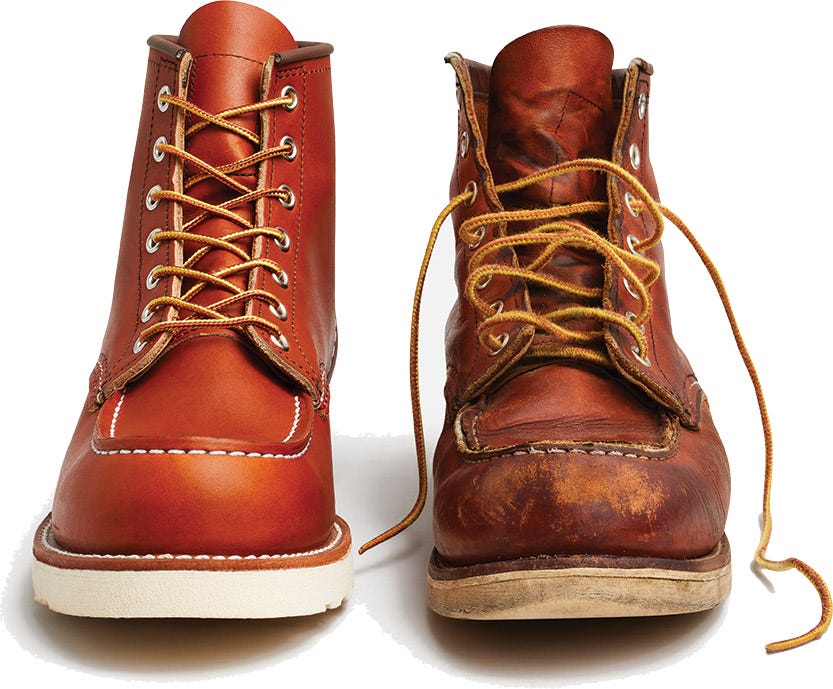
These details tell a story.
That is how Red Wing made the transition from a purely functional workwear company to a cultural icon. Not by reinventing itself, but by staying the same while the world around it changed.
Today the brand lives in two worlds at the same time.
On one side, it still supplies safety footwear to workers in demanding industries around the globe. On the other, its Heritage line has become a staple in fashion, design, and craft communities.
Very few brands manage this balance.
2. Product Obsession as Brand Strategy
If you look at the company from the outside, something unusual becomes visible very quickly:
Red Wing behaves less like a fashion brand and more like a manufacturing company that happens to have a brand attached to it. They are obsessed with quality.
That difference shapes everything.
More than a century after its founding, the core philosophy has barely changed: build boots that solve real problems and improve the product, rather than constantly reinvent the story.
Many of the brand’s most recognizable models have existed for decades. The Iron Ranger, originally designed for iron miners in Minnesota’s Mesabi Range, dates back to the 1930s. The Classic Moc, first introduced in the 1950s for hunters and farm workers, remains one of the company’s flagship products today.
What is remarkable is not just that these models still exist.
It is that they still look almost the same.
While most fashion brands introduce new collections every season, Red Wing built its reputation around a small number of icons that evolve slowly over time.
Even celebrities who have access to every luxury brand gravitate toward them. Ryan Gosling and Timothée Chalamet wear them regularly. Not because they are new or exclusive, but because they look worn and lived in. The boots carry the marks of use, which is exactly what they were designed for.
This philosophy is embedded in the construction itself.
Most Red Wing Heritage boots use Goodyear welt construction, which allows the sole to be replaced instead of discarding the entire shoe. Thick full-grain leather and heavy stitching make the boots repairable rather than disposable.
As Albert Muzquiz, writer for Heddels, a publication focused on craftsmanship and durable goods, explains, this construction method is one of the reasons Red Wing developed a reputation for longevity among workers long before the brand became fashionable.
Customers do not buy Red Wing boots expecting novelty.
They buy them expecting permanence.
And that changes the role of marketing. Red Wing does not build its brand through constant reinvention.
It builds it through consistency.
A small set of products.
Built the same uncompromising way.
For decades.
That kind of discipline is rare in modern branding.
And it is exactly what makes the brand so powerful.
3. Campaigns that Show, not Tell
Most brands use campaigns to create meaning.
Red Wing uses campaigns to reveal what is already true about the product.
This difference is subtle but powerful.
Instead of inventing grand brand narratives, Red Wing’s marketing often focuses on something much simpler: the life a pair of boots lives after it leaves the store.
One of the clearest examples is the campaign “Will Your Wings” which I featured as a best practice example for sustainability in my 2026 marketing trend report. FRICTION RELOADED.
The idea is beautifully simple. A pair of Red Wing boots is shown together with two owners. First the person who wore them for years. Then the next person who inherited them.
One pair of boots. Two lives.
The message is not about style. It is about lifespan.
It talks about sustainability through something people actually want: durability.
Boots that survive decades. Boots that carry stories.
The campaign highlights a truth the company has always built into the product. As Red Wing’s Heritage marketing team explained when presenting the idea, the goal was to show that the boots
“become part of a person’s life and continue that life with someone else.”
In other words, the product accumulates meaning through time.
Instead of explaining sustainability, it simply shows what durability looks like.
The second campaign example is “Made the Hard Way”.
The idea starts with a simple cultural observation.
We live in a world obsessed with convenience. Faster production. Faster delivery. Faster consumption.
Red Wing deliberately stands for the opposite.
The line “Made the Hard Way” does not just describe the product. It frames difficulty itself as a marker of value.
But the genius of the campaign is in the execution.
The films were shot on 16mm film, the billboards were literally hand-made, and even product drops were executed “the hard way.” The production process itself followed the same philosophy as the boots.
The medium mirrored the message.
The campaign did not just say that Red Wing rejects shortcuts.
It behaved that way too.
That is what makes it so strong.
Most brands try to remove friction from their story.
Red Wing turns friction into proof.
Hard to make.
Hard to fake.
Hard to replace.
That is what makes it more than heritage advertising. It translates the brand’s manufacturing logic into a contemporary cultural stance. 
Creative Review described the campaign as a rejection of “today’s culture of shortcuts and convenience,” positioning Red Wing as a symbol of patience and precision.
The genius, then, is not nostalgia. It is strategic inversion.
That is friction in marketing used well.
4. The Nostalgia Challenge
Nostalgia or heritage is one of the most powerful assets a brand can have.
It is also one of the most dangerous.
Many old brands eventually turn into museums of themselves. They repeat the same stories, celebrate their past, and slowly lose relevance in the present. Heritage becomes nostalgia. And nostalgia rarely builds future demand.
Red Wing faced the same risk.
A company founded in 1905, famous for traditional work boots, could easily have become a relic of American manufacturing history. Instead, something different happened.
The brand protected its core while allowing its meaning to evolve.
Originally worn by miners, farmers, and factory workers, Red Wing boots slowly entered entirely different environments. Designers, craftspeople, and creative communities began adopting them. Japanese vintage culture played a particularly important role in this transformation. In the 1990s and early 2000s, Japanese workwear enthusiasts rediscovered American heritage brands and treated them almost like collectible artifacts.
That attention gave Red Wing a second life.
Fashion writers often describe Red Wing boots as “trend-proof,” precisely because their design sits outside seasonal fashion cycles. The product remains constant while the audience around it changes. GQ described Red Wing’s appeal precisely with this tension:
“The boots are rooted in workwear but continue to resonate far beyond it because they ignore the seasonal logic of fashion.”
This reveals the real strategic move behind the brand.
Red Wing does not try to modernize the product.
It modernizes the context around the product.
Instead of redesigning the boots every season, the company created the Red Wing Heritage line, opened carefully curated stores, collaborated selectively with fashion retailers, and allowed cultural communities to reinterpret the product.
The product stays the same. The meaning changes.
That is the difference between nostalgia and heritage.
Nostalgia freezes the past.
Heritage builds products strong enough to survive changing cultural moments.
5. Strategic Marketing Lessons
To sum up this deep dive into one of my latest favourite brands, let’s look at 3 things we can learn from Red Wing for our brands marketing strategy:
1. Don’t talk about sustainability.
Red Wing rarely talks about sustainability.
Yet the product model is inherently sustainable.
Boots designed to last decades replace dozens of disposable alternatives.
The lesson is simple: Sustainability works best when it is a consequence, not a promise.
Because the hard truth is: 99% of people don’t want sustainable shoes.
They want shoes that make them look good, sexy, desirable. That are comfortable to wear (after you break them in) and that last long.
Durability is sustainability without moral pressure.
Consumers often resist sustainability messaging because it feels like sacrifice.
Red Wing reframes it as product superiority.
The most convincing sustainability strategy is building products people refuse to throw away.
2. Show the real stories.
Red Wing’s marketing does something rare.
It does not try to create a narrative around the product. It simply shows what is already there.
Campaigns like “Will Your Wings” or “Made the Hard Way” do not exaggerate. They highlight the real life of the boots. The people who wear them. The process of making them. The years they survive.
The strongest marketing does not manufacture meaning.
It reveals the truth that already exists in the product.
3. Protect the core. Let culture reinterpret it.
Many heritage brands make the same mistake: They try to stay relevant by redesigning the product.
New shapes. New logos. New collections.
In the process they slowly lose what made them special.
Red Wing chose a different path.
Instead of redesigning the product, the brand placed it into new cultural contexts. Campaigns featuring craftspeople and makers. Collaborations with fashion retailers. Carefully designed stores. Editorial storytelling that highlights wear, repair, and longevity.
Give culture new ways to discover it.
Marketing becomes the bridge between an unchanged product and a changing world.
Final Thoughts
In a world obsessed with removing friction, Red Wing proves the opposite.
The right kind of friction creates value. It makes it last. And thus creates memories.
I especially like their approach to sustainability. Because it addresses something customers actually want, not just an abstract idea.
Sustainability works best when it is built into the product, not added to the marketing.
Maybe that’s the real lesson behind Red Wing.
Build things people want to keep.
Thanks for reading,


